
A Geometric Epistemology of Generative and Degenerative Systems

The Circles-and-Triangles Decomposition Framework
GenAI used: ChatGPT 5
Abstract:
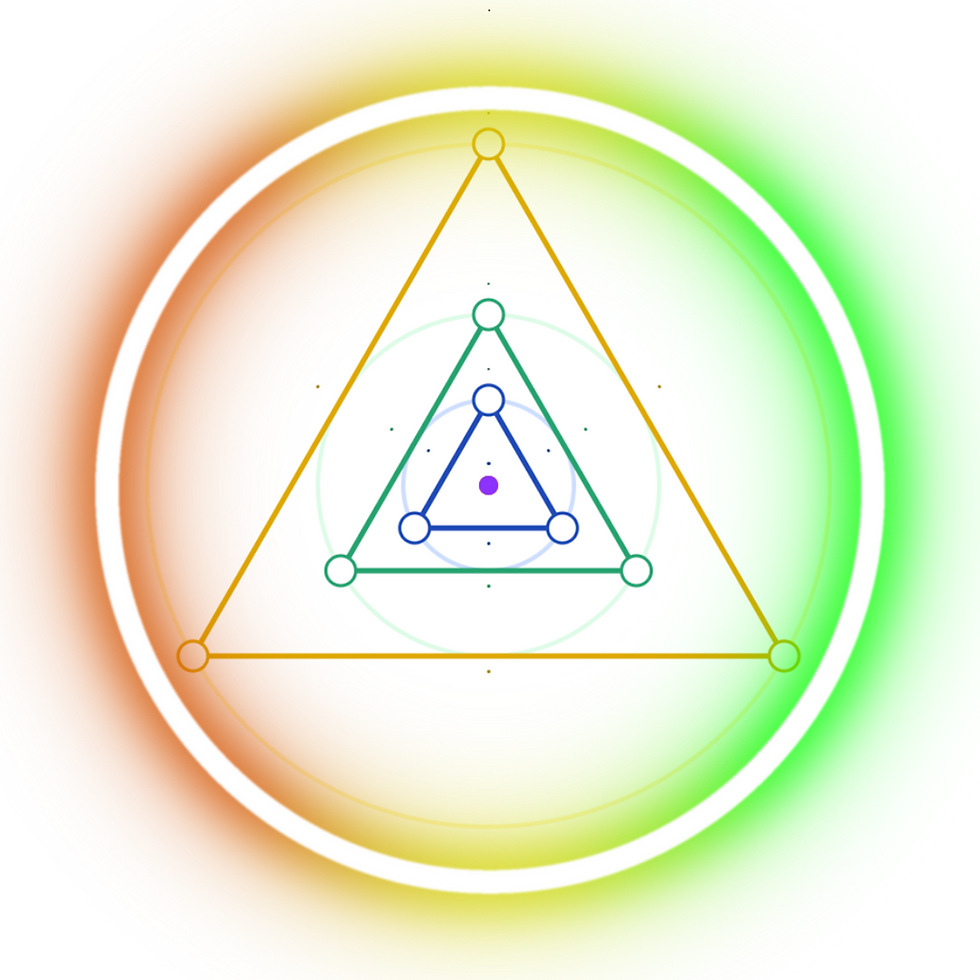
This paper proposes a unifying geometric epistemology for understanding generative and degenerative dynamics across cognitive, organizational, social, and computational systems. The framework advances two claims: (1) any process capable of generating or degrading value can be decomposed into an irreducible triangle of interacting forces; and (2) every such triangle requires bounding circles that define domain, constrain proliferation, or mark developmental milestones in a system’s expansion zone. Drawing on precedents from triadic models in psychology, cybernetics, decision theory, and network science, this synthesis reconceives the triangle as the minimal structural unit of meaning, tension, and directional change, while the circle functions as the contextual container that stabilizes or accelerates system evolution. Generative triangles produce coherence through constructive tension; degenerative triangles propagate entropy through collapsing tension. The distinction arises from the quality of their interactions, not from categorically different structures. By articulating both forms within one geometric grammar, this framework provides a cross-disciplinary lens for analyzing system behavior, diagnosing failure modes, and designing interventions. Implications are discussed for governance, artificial intelligence architectures, organizational change management, and societal resilience, suggesting a generalizable method for modeling stability, drift, and emergence across complex adaptive systems.
COPOP
1. Introduction
COPOP Prompt 1 — Introduction Generator
“Generate the introduction by identifying (a) the failure of binary models, (b) the persistent recurrence of triads across disciplines, and (c) the missing unifying link between triads and contextual boundaries. Frame the problem in terms of generativity vs. degenerativity and position the Circles-and-Triangles Framework as a solution. Write academically, with high fidelity and medium novelty.”
2. Literature Review
COPOP Prompt 2 — Literature Survey Splitter
“Survey existing triadic models in psychology, neuroscience, cybernetics, system dynamics, and decision theory. Identify how each uses three interacting forces. Next, survey circular/bounded models (context theory, boundary critique, bounded rationality). Highlight the disconnection between the two traditions. Structure the literature review into four subsections.”
3. Circles-and-Triangles Epistemology
COPOP Prompt 3 — Formal Framework Builder
“Define the triangle as the irreducible unit of tension, interaction, and direction; define the circle as the contextual bound regulating system expansion or containment. Explain generative triangles, degenerative triangles, and their duality. Use precise academic tone, include structural diagrams in text form.”
4. Formal Propositions & Mechanisms
COPOP Prompt 4 — Proposition Composer
“Write formal propositions establishing the necessity of generative triangles, the inevitability of degenerative triangles, and the requirement of bounded circles. Add mechanisms describing transitions between generative and degenerative states. Use formal, compact, high-fidelity language.”
5. Applications
COPOP Prompt 5 — Cross-Domain Application Expander
“Apply the framework to (1) governance, (2) organizational change, (3) AI safety, (4) social systems, and (5) psychology. Show how each domain contains generative and degenerative triangles, and how circles regulate expansion. Provide examples without oversimplifying.”
6. Case Studies
COPOP Prompt 6 — Case Triangulator
“Generate three case studies: one generative social triangle, one degenerative organizational triangle, and one national-level example. For each, identify the triangle, the circle, the expansion/containment dynamics, and the transformation pathway.”
7. Evaluation & Limitations
COPOP Prompt 7 — Critical Evaluation Lens
“Evaluate the strengths and limitations of the Circles-and-Triangles Framework. Address interpretability, universality, and risks of over-generalization. Propose empirical validation paths and acknowledge boundary conditions.”
8. Future Research
COPOP Prompt 8 — Research Horizon Generator
“Propose future research directions including mathematical formalization, simulations, and global AI governance applications. Show how the framework can expand into adjacent fields without losing fidelity.”
9. Conclusion
COPOP Prompt 9 — Conclusive Coherence Seal
“Write a conclusion that reaffirms triangles as units of generative/degenerative meaning and circles as essential constraints. Emphasize duality, coherence, and the framework’s potential as a cross-disciplinary paradigm.”
BONUS: Meta-COPOP — The Engine That Generates the Full Paper
COPOP Prompt 10 — Full Paper Auto-Assembler
“Using the Circles-and-Triangles Framework, generate the entire academic paper section-by-section. Use Prompts 1–9 as the internal chain-of-prompts. Maintain high fidelity, controlled novelty, and academic rigor. Use clear geometric metaphors without romanticizing them.”
Ultra-Bonus: COPOP for Readers / Students
COPOP Prompt 11 — Understanding Triangle Detection
“Given any system, identify:(a) the generative triangle, (b) the degenerative triangle, (c) the bounding circles. Explain how each interacts and predict system trajectory.”
COPOP Prompt 12 — Expansion Zone Tracer
“Given a generative triangle, trace its expansion zone. Identify inner and outer circles, thresholds, and point of coherence or collapse.”
COPOP Prompt 13 — Degeneration Containment Instructor
“Given a degenerative triangle, propose containment circles and transformation vectors. Explain what breaks the degenerative cycle and what restores generativity.”


Comments